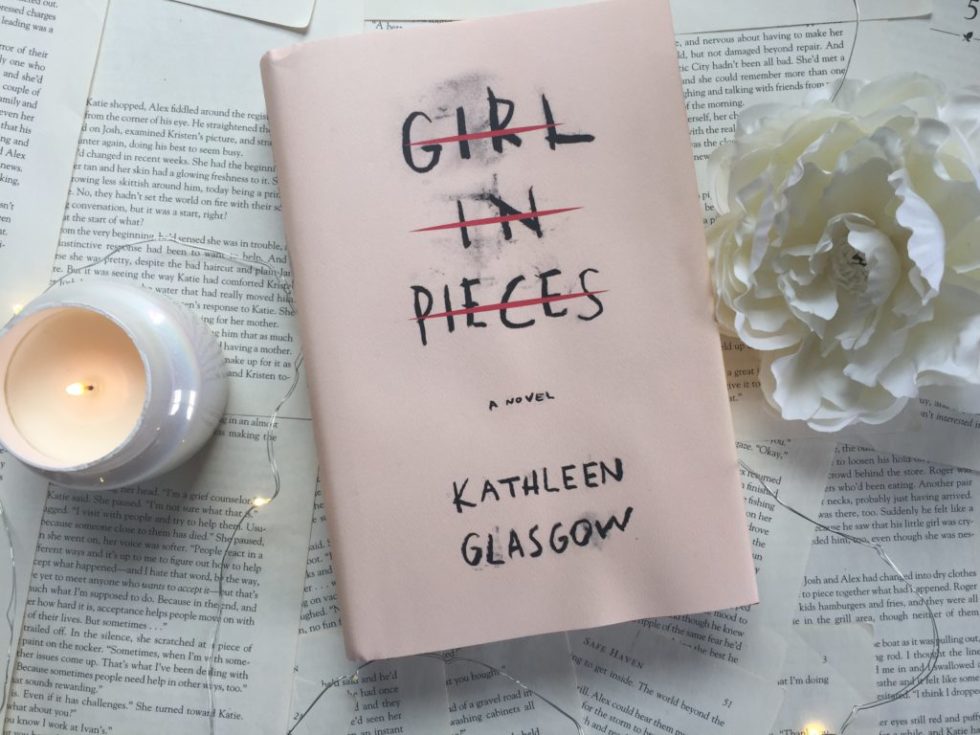


Kathleen Glasgow’s semiautobiographical debut novel, “Girl in Pieces” combines complex characters in a beautiful, artistic writing style that conveys a powerful message of recovery from self-harm. This type of story and theme is vital in today’s society—and campus life—as, according to Mental Health America, studies show that anywhere from 17% to 35% of college students have been reported to self-harm.
The theme throughout the book is one of recovery and hope, even when the main character, Charlie Davis, feels there is none. The narrative begins with Charlie in Creeley, an inpatient treatment center for girls who self-harm. Charlie arrived there after a hospital stint due to nearly bleeding out following a suicide attempt. Throughout her time at Creeley, and help from her therapist, nicknamed Casper, Charlie slowly begins to recover—until her world is once again flipped on its head and she is released from the center. The reader then follows Charlie as she navigates trying to recover in the reality outside of the safe walls of inpatient. What is unique about this story is that it is what is known in the reading community as an “own voices” book, meaning that Glasgow writes from personal experience. She is so adeptly able to capture Charlie’s struggle because she has been there. She has been where every self-harmer has—and she recovered. In “Girl in Pieces” Glasgow uses Charlie as an example to other young girls—and boys—to show that it is possible to recover.
Throughout the narrative, the characters display incredible complexity, even if only on the page for a moment. Two standouts include Blue, an initially hostile girl from Creeley, and Linus, a mysterious coworker at True Grit, the coffee shop at which Charlie eventually finds herself. Blue begins the story constantly antagonizing Charlie and belittling her, calling her names like Silent Sue and forcing her to share feelings she’s not ready to share. However, as the plot moves along Blue grows and changes in a way the reader will likely not expect. Similarly, Linus begins as just another of Charlie’s coworkers. However, through different comments she makes and different events, it is shown that there is more to Linus than meets the eye, or, to put it another way, more to her than what is written. Even the ‘boyfriend’ character is complex in a way that makes it unclear whether the reader is meant to root for or against him. Glasgow’s characters are not all evil but they are not all good either, which is what makes them realistic. Readers want to root for the characters, even when they are making bad decisions because the reader can see pieces of themselves in each character.
Glasgow’s writing style throughout the storyline is artistic in its descriptions, yet at the same time, true to character in the way teens and young adults who have been through what Charlie goes through, speak. Opening the narrative Charlie tells the reader “I remember the stars that night. They were like salt against the sky, like someone spilled the shaker against very dark cloth. That mattered to me, their accidental beauty. The last thing I thought I might see before I died on the cold, wet grass.” Of course, Charlie does not die, but the entire book is filled with beautiful lines such as that. There are also more realistic things Charlie does or says, such as the fact that whenever she even so much as thinks about the man who attempted to sell her as a prostitute she always refers to him as “F*cking Frank.” Never in the course of the plot is he ever referred to as anything else.
“Girl in Pieces” is a hauntingly relevant work in today’s climate. To parents, “Girl in Pieces” can warn them about what their children may be struggling with; to someone in Charlie’s position, this story can work to help show that recovery is possible, even when everything around them seems to be falling apart; and to teens and college students not in Charlie’s position, it can help them to possibly understand what their peers are going through and how to help them.
To get help for self-harming, text the crisis text line 741-741. For help with suicide, call 1-800-273-8255.
Photocredit: Falon Loves Life

0 Comments