

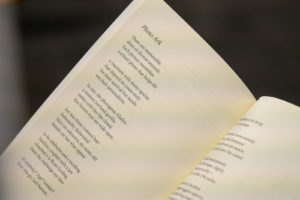
Cecil College is known for many things, from their robust program offerings to its affordable prices and readiness to offer financial aid, but one of the most unique things Cecil is known for is its talented faculty. Every department is filled with experts in their respective fields, who not only offer students a solid education but also truly want to see their students succeed. One such professor is Nathanael Tagg from the English Department. In addition to teaching English 101, 102, and Creative Writing, Tagg has recently published his first book of poetry entitled “Animal Virtue.”
On Monday, March 26, Tagg held a reading of his new book in the Writing Center at Cecil. The reading was open to faculty and students alike and Tagg read several of his poems from the book including “Definition of animal virtue” which, as it sounds, defines the title of his book.
Upon being asked to define his poetic style Tagg states, “In my poems, I try to use wit, nature imagery, surprising facts and metaphors, biblical or literary allusions, art commentary, and musical language to explore the challenge of living well. I hope my poetry provides a nourishing blend of consistency and variety, traditional poetic form, and experimental structure, humor, and seriousness, lyric and narrative, euphony and cacophony, clarity and mystery, etc. I aim for form and content that mesh, clash, or both in a thought-provoking way. I want there to be layers of meaning, from the obvious to the subtle, so that readers can discover something new via rereading so that different readers can observe different things and devise their own interpretations. Some poets seem afraid to write about anything as if poetry always has to hint toward the ineffable. I like writing about identifiable themes so that my poems are accessible and can be enjoyed by people who aren’t graduate students, professors, or other writers. I hope readers can relate to and appreciate my poetic longing for healthier relationships between people and between humanity and the environment—also my desire to see in religious texts meaningful archetypes, not dogma, and to see in literature personally relevant themes, not academic mental masturbation.”
Tagg reveals where his journey with poetry began and states that “College English classes sparked my love of poetry, and it turned out I had a knack for using poetic language, even in prose. At least one of my professors said my essays sounded like poetry. I wrote a bad imitation of “Howl” by Allen Ginsberg and pinned it to a bulletin board on my campus. My creative writing class forced me to write on a regular basis. But I stopped.”
Writing poetry successfully in a modern world is not an easy task and Tagg’s path was not always linear. He recalls early in his academic and professional life that “Trying to publish my writing, earn money from it, finish graduate school, and become a professor seemed too risky and difficult, so I decided I’d become a high school English teacher. I chickened out, though, a few weeks before I was supposed to start student teaching. Luckily, my Shakespeare professor encouraged me to go to graduate school, which I did. I earned my MA in English while I taught as a graduate teaching assistant. I planned to earn a Ph.D. next, but I didn’t have a research focus. Also, I’d grown up in an evangelical family but realized I was no longer a believer. Rather than dwell on my faith or grad school plan—or lack thereof—I found myself writing poetry. One Easter morning, I saw a crow picking apart a bunny. That image, plus my emotional state, struck me as a ready-made poem, which I started writing that morning. It was published a few months later. That first publication motivated me to take my writing more seriously. While I taught college English part-time as an adjunct, I kept writing. I became more of a writer and teacher than a scholar.”
When asked what inspires him to write, Tagg responds, “Rarely am I inspired in the sense that I just have to write, I know exactly what to say, and I can write it easily and quickly. But I’m committed to being a productive writer. So— whether or not I feel like it—I force myself to write at least several times a week. I’ve grown to love the writing process—the difficult and slow but enjoyable act of ruthless revision. Writing itself can be as pleasurable as finishing a poem, or publishing it, or reading it to people. Writing poetry also just allows me to be myself.”
He continues by saying, “my sources of inspiration are numerous. I glean ideas (plots, images, metaphors, etc.) from relationships, work, nature, science, religion, the news, literature, etc. After an idea comes to me, I add it to a note on my phone. Eventually, I transfer the note to my writing journal, a Word document on my computer. To start a new poem, I first read several pages of my journal. I find that some of the ideas are related thematically or metaphorically or sonically. I copy and paste those into a separate document. I free-write about them, letting my imagination run wild. It’s a lot like meditating—just allowing consciousness to happen: noting but not judging it. I know the poem has begun to work once I’ve written something unexpected and better than what I might have planned. I revise it for days or months or years. I love to take life and put it in the poetry machine. Who knows what will happen?”
He credits poetry for being the reason he “can have a career.” He explains, “My quirks can be strengths rather than weaknesses. These include my introversion, my sensitivity, my irreverence, my tendency to make unusual connections between disparate things, etc. I can make meaning with my imagination rather than just accept received wisdom from religion, science, mainstream culture, etc. I can have a sense of struggle and ritual and being a part of something larger than myself. I can feel awe and gratitude, as well as plenty of difficult mixed emotions. I can better know myself and the world by looking closer. I can enter a higher state of consciousness. Thank you, Poetry!”
Copies of Tagg’s book are available online through Amazon or Barnes & Noble. To learn more, visit Professor Tagg’s website: www.nathanaeltagg.com.
0 Comments